The Freelite assay is composed of two sensitive and specific immunodiagnostic tests to measure kappa (κ) and lambda (λ) free light chains (FLCs).
The assays are based on affinity purified sheep polyclonal antibodies that are coated onto latex particles for enhancement of the test sensitivity.
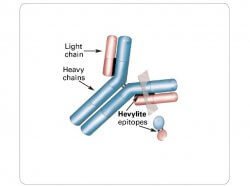
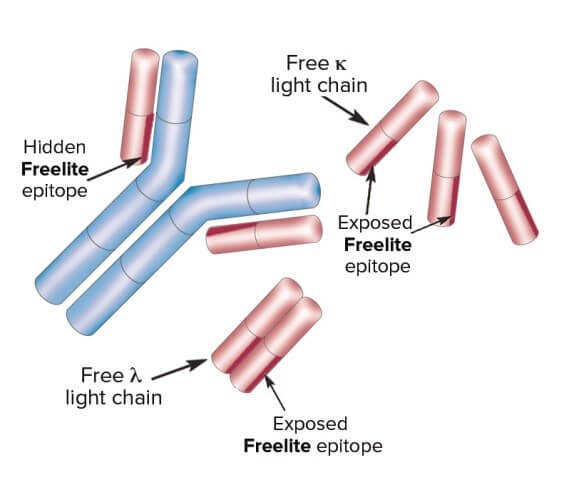
Freelite reacts only with exposed free light chain epitopes which are hidden when the light chain is bound to the heavy chain.
Freelite is recommended for use in patients with monoclonal gammopathies including:
- Light Chain Multiple Myeloma (LCMM)
- Intact Immunoglobulin Multiple Myeloma (IIMM)
- Smouldering Multiple Myeloma (SMM)
- Non secretory Multiple Myeloma (NSMM)
- AL amyloidosis
- Monoclonal Gammopathy of Undetermined Significance (MGUS)
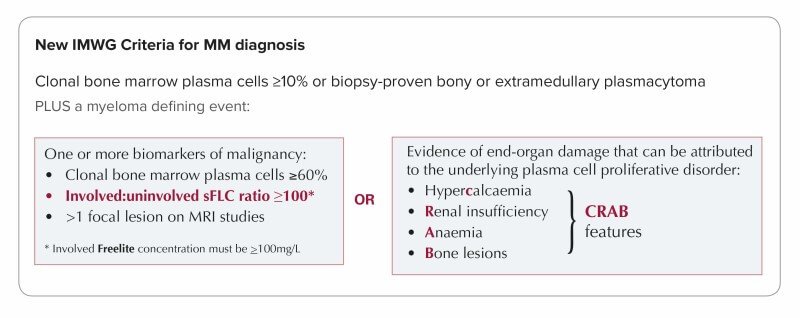
It is the only free light chain assay recommended by national and international guidelines
Test results
| Term | Definition | Description | Example in a Lambda LCMM patient |
| FLC | Free Light Chain | ||
| iFLC | Involved FLC | The FLC type produced by the tumour | λ |
| uFLC | Uninvolved FLC | The alternate light chain type to the iFLC | k |
| k/λ sFLC ratio | k/λ | A ratio of the concentration of κ to λ sFLC (indicates monoclonality) | k/λ |
| dFLC | iFLC – uFLC | The difference in the concentration between the iFLC and uFLC | λ-k |
| Involved/ Uninvolved sFLC ratio | iFLC/uFLC | A ratio of the concentration of involved to uninvolved sFLC – could be κ/λ or λ/κ | λ/k |
| Normal adult serum | 95 percentile range |
| k FLC | 3.30 – 19.40 (mg/L) |
| λ FLC | 5.71 – 26.30 (mg/L) |
| k/λ FLC ratio | 0.26 – 1.65 (0.37-3.1 for patients with renal impairment) |
An abnormal κ/λ FLC ratio is a highly sensitive indicator of monoclonal κ or λ FLC in serum.
A Laboratory Overview
Freelite quantitatively measures serum kappa and lambda free light chains (FLCs) and is recommended for use in initial testing, monitoring and prognosis of patients with suspected monoclonal gammopathies.
Performing Freelite and serum electrophoresis analysis provides an efficient initial diagnostic screen, and means that urine electrophoresis can be ordered more selectively.
Freelite is:
- A simple and sensitive latex-enhanced immunoassay
- Based on polyclonal antisera to ensure recognition of the widest variety of FLCs
(κ and λ chains are highly polymorphic, and thus can be easily omitted by monoclonal antisera-based assays)
- Provides quantitative results quickly – results typically within 30 minutes
- Recommended by International and National guidelines (ASCO, ESMO, NICE, IMWG)
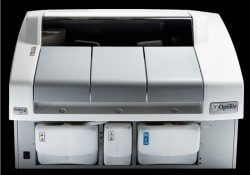
- Available on different analysers including Optilite and SPAPLUS analysers from the Binding Site specifically designed for testing of specific proteins
- Significantly higher sensitivity than electrophoretic methods for the detection of FLCs
- Reliable results, with excellent precision, batch-to-batch reproducibility and linearity
Precision
Freelite assays show excellent precision and reproducibility to give you confidence in the consistency of each reagent batch. Freelite assay precision is tested by following strict CLSI guidelines.
An independent study gave the following results for Freelite reproducibility based on ten replicates
| Kappa Serum Free Light Chains | Lambda Serum Free Light Chains | |
| Coefficient of Variation (%) | Coefficient of Variation (%) | |
| Within-batch | 9.76 | 7.64 |
| Between-batch | 7.12 | 7.02 |
Freelite Assay Menu and Kits
Optilite
| Kit | Product Code | Kit size | Measuring Range | Sample Type |
| Freelite κ | LK016.OPT | 100 tests | 0.6 – 127000 mg/L | Serum, plasma |
| Freelite λ | LK018.OPT | 100 tests | 1.3 – 139000 mg/L | Serum, plasma |
Availability on other instruments
- Beckman Coulter: IMMAGE®, IMMAGE 800
- Roche: Cobas® c501, c502
- Siemens: ProSpec™
Clinical laboratory practice
Serum free light chain assays are included in a range of International guidelines including:
- International Myeloma Working Group
- The National Comprehensive Cancer Network
- European Society of Medical Oncology
- American Society of Clinical Oncology
- International Kidney and Monoclonal Gammopathy Research Group (for unexplained Acute Kidney Injury)
*All data used in these guidelines was generated using the Freelite® free light chain assay.
It cannot be assumed that other commercially available free light chain assays will give compliance with these guidelines